
the sixth-form experts

Call us now for advice
0208 767 8666

CIFE General News Articles

  • A levels remain highly valued

    Article in summary

    Stuart Nicholson, current Chairman of CIFE, writing in 2010, explains that A levels are still the most popular pre-university option because they allow a student to focus on what most interests him or her, yet the range of subjects enables wide choice and permits both specialised and broad programmes of study. A levels remain highly valued for their rigour, taking students to a high level of competence, and they remain the qualification of choice for entry to university.

    Article in detail

    The Council for Independent Education (CIFE), whose member colleges specialise in A-level tuition, has seen a surprising 62% increase in the last three months in helpline website visits compared with the same period last year (April-June 2010: 5958; April-June 2011: 9663).

    This trend is expected to continue over the next few months, in spite of a prevailing context of negativity towards the A-level system expressed by some educationalists, including recent critical remarks by the Secretary of State for Education, Michael Gove.

    A spokesman for CIFE offers the following, more favourable, perspective on A levels. Stuart Nicholson, Principal of Cambridge Centre for Sixth-form Studies, explains why A levels are still so popular, with both British and overseas students. He writes:

    “In addition to its large cohort of British students, Cambridge Centre for Sixth-form Studies (CCSS) enjoys having forty other nationalities represented in its student body. Although CCSS considered and rejected the idea of offering other pre-university qualifications, the breadth of our geographical intake demonstrates the global appeal of the A-level structure.

    What do our international students find so appealing about A-levels? This is a very significant question, not only for us as an individual college, but for the English/Welsh sixth form system as a whole. I interview most of our students during their application process and it is fascinating to learn about the variety of the educational systems in their home countries. Generally classes are large, on average definitely larger than the average classes in the British state schools that our UK students tell me they have experienced. Typically their schools however are rather smaller, and it seems that few schools have as many as 100 pupils in a year group. Almost all countries have in common a great breadth to their compulsory subjects, which all students have to study until they are 18. The narrow and deep specialism of A levels contrasts quite dramatically with the broad and shallow general education to be found elsewhere in the world. I often ask students about what they would study in their own country prior to university. The largest number of subjects was twenty-seven and, whilst this was exceptional, it has certainly been the case that most countries operate a sixth-form diet that, in terms of breadth, would look more familiar to us as a GCSE offering.

    The appeal of A levels is therefore perhaps obvious: the opportunity to specialise and to focus on the subjects that the individual finds interesting and is good at. This is unquestionably true and frequently a cause of enthusiastic sparkling in the eyes of our prospective students when we are talking at interview. A less obvious appeal is the range of subjects which can be studied at A level. Most countries insist on a broad range of traditional subjects being followed and the discovery of the possibilities offered by A levels is an absolute revelation to many international students, who find subjects that barely exist as undergraduate studies at home, let alone as pre-university options. From the social sciences of business studies and psychology, to the enormous range of modern languages, the visual arts as diverse as fashion and photography, as well as the more traditional subjects – our international students are delighted by the choices available to them.

    Choice and specialisation are hugely attractive, the examinations are widely respected, and both UK and international students value them very highly indeed.

    But what of the alternatives? What about the perceived rigour of the Cambridge Pre-U, the currently fashionable breadth of the International Baccalaureate, the apparently direct path of the University Foundation Programme? These are all important points and we have considered them all before confirming our commitment to A levels a couple of years ago.

    As to rigour, all our finest universities still overwhelmingly use A levels as the basis of their offers and my view is that they are recognised globally as the bedrock of our excellence in school education. I am also very pleased that, in my experience, across the world, the best UK education remains viewed as the gold standard: quite simply the best secondary education there is. As to breadth, it is a fallacy that breadth is impossible within the A level structure. Since the advent of AS levels, it is far from unusual for students have a mixed diet of, say, History, Philosophy, Maths and Italian. Furthermore, another peculiarity of the UK system is the flexibility of admissions to university with very little restriction of suitable subjects at A level as entry qualifications for most courses. So you can study a degree in Politics or Business, for example, with almost any combination of A levels. University Foundation programmes are very popular at some colleges as a perceived “direct” route into a degree, but they lack the wide acceptance that A levels do as intellectual “hard currency”. A levels give bright students qualifications that are tradable for entry into any good university.

    It seems to us that the success of A levels is no coincidence. They present interesting and challenging courses, with opportunities for the narrow specialist and the broader generalist within a framework of rigorous syllabus specifications and a respected examination structure. Our UK students love them; our international students love them; so do we.”
     

  • Better students take Easter Revision

    Article in Summary

    Better students take Easter Revision nowadays. Students in 2012 are much more likely to be hunting A grades than just trying to avoid a fail. The article looks at case histories and explains the pressures which have driven the surge in demand for Easter Revision courses.

    Article in detail

    Revision courses run by independent schools and sixth-form colleges during the Easter holi­days have been around for at least 30 years, but, as explained below, the type of student who attends these intensive one week A-level and GCSE courses has changed a great deal in recent times.

    According to Chris Kraft, principal of Duff Miller College in Kensington, which has run intensive one-week Easter revision courses since the 1980s,”there is less demand from weaker students aiming to turn potential failure into a low pass grade. The typical A-level students on this type of course nowadays are well-taught in their subjects and already understand the content and concepts required. They are heading for a goodish grade, but in order to get above a B they need to learn how to jump through the hoops set by the examiners. They are usually bright and well-motivated, but need much greater exposure to past paper ques­tions, including under timed condi­tions.

    Mike Kirby, principal of Ashbourne College, a specialist A-level and GCSE college, agrees. “The vast majority of those who come on our Easter revision courses are able stu­dents, with good predicted grades, who need someone else to kick-start and organise their revision. If we put the appropriate amount of pressure on them in April they respond well and can keep up a higher work-rate until the June exams. We don’t get many E-grade students trying to improve to Ds anymore.”

    Luis Pinto went to Duff Miller last April to do a physics revision course and says: “I wasn’t scoring well in my practice exams at school. I was only predicted a B/C grade, so my parents were quite worried. The revision course really helped me with exam technique and showed me exactly what kind of answers the examiners were looking for. In the end I scored an A, so I’ll definitely be taking East­er courses again for my A2s this year.

    The intensely competitive nature of admission to top university cours­es has also seen a growth in numbers of what Kraft calls “the well-oiled high-flier” who has been predicted A or A* grades at A-level but needs to make sure. With the many UK uni­versities now demanding A’s for at least some of their undergraduate courses, the best students, often encouraged by nervous parents, are opting for what they see -as an insur­ance policy against failure by taking Easter revision courses. James Bar­ton, course director of Easter revision courses at MPW College, also in Kensington, said this week: “We see a lot more students than five years ago who are at the top end of the spec­trum. They have been predicted A grades and see these extremely exam-targeted, technique-driven courses as invaluable in helping them to secure As and A*s.”

    Early signs indicate that demand will be strong for Easter revision courses again this year. Sally Powell, principal of Collingham College, reported there had been double the number of sixth-formers enrolled on their one-week courses in the Christ­mas holidays. “Most students seem to have decided that only good universi­ty degrees are worth striving for in the, current economic climate,” she says. “They are rejecting the old idea of ‘Oh well, I’ll in somewhere if I drop a few grades’. However high their predicted grades, there is a greater urgency than there used to be to get the best grades they can.

    Kirby agrees that economic pres­sure is driving students not only to aim for the more sought-after univer­sities, but also for more vocational courses that will lead more easily to jobs after graduation. “It is no sur­prise that by far the most popular Easter revision subject is mathemat­ics, followed by the sciences, then economics and business studies.

    This pattern is partly explained by the difficulty of grouping together students from different schools on a revision course who are studying a wide variety of options in, say, history or English literature. Nevertheless, Powell says that last Easter her English literature teachers managed to cover 60 different texts over three weeks in individual tuition.

    Courses cost between £350 and £500 a week (around £120 more if residential). There are many inde­pendent sixth form colleges, the best of which are members of the CIFE. Some major public schools run day and residential cours­es, or you can approach a private tutor or agency that has been recom­mended by a satisfied previous stu­dent.

    Most importantly, don’t leave your enquiries until the end of term – the best courses fill up fast!


  • The value of Independent sixth form colleges

    Article in summary

    In this article, written for the 2012 edition of the First Eleven Schools Guide, James Wardrobe describes the origins of independent sixth form colleges and the benefits they offer university-bound students: good course choice, small classes and a strong focus on examination technique.

    Article in detail

    Origins of sixth form colleges

    Independent sixth form colleges in the UK, often still referred to as tutorial colleges, have a rich and varied history. For example, Davies’s College, founded in 1927, and DLD College, starting in 1931 first opened their doors to provide tutoring for Oxbridge, the Armed Services and Colonial Service entrance exams. After the Second World War the tutorial colleges specialised in A-level and 0-level teaching, and often still retained the rather derogatory nickname of “crammers”, a term first used over 100 years ago in a time when schools didn’t focus on exams at all. Times have changed, however, and their modern versions, the Independent Sixth Form Colleges, are quite different in almost every respect, although most stress the exam-orientated nature of their courses and all pride themselves on their small teaching groups. At a rough estimate, there are currently over 100 such colleges in the UK, located nationwide from Exeter to Edinburgh. Most are situated in large towns and cities, though there are also a number of successful boarding colleges in the countryside.

    Wide choice of subjects and courses

    The value of Independent sixth form colleges over a school’s sixth form lies in the wider range of choice of subjects and much greater flexibility of subject combinations. Most colleges allow students to pick a varied combination of subjects and there are commonly over 40 different AS and A-level subjects to choose from. If you want to take an unusual package such as Accounting, Psychology and History, this will be a more feasible possibility in a college than in a school sixth form timetable. If you want to join a college for the second year of A level, not only will you find many colleges which can provide the right A2 courses, but most will allow you to combine A2 courses with a new AS level or even a subject in which you cover both the AS and A2 during the year. So, apart from the variety of subjects, different types and lengths of A-level course are also available. At colleges such as MPW, Ashbourne, Collingham or Lansdowne (all in London), you will find standard two-year courses, final-year (ie second year) courses, one-year courses (covering AS and A2 modules) and retake courses.

    Although the majority of students will be studying A levels, most colleges run equally flexible GCSE courses, usually offering subjects such as Photography as well as all the mainstream ones. As well as one-year courses, two-year GCSE courses for Year 10 pupils are also available at those colleges, which are registered as schools by Ofsted

    Focus on good teaching and support

    The best colleges have experienced teachers who are A-level subject specialists. They are often examiners for the syllabuses they reach They have the advantage of being able to specialise in their subject at a particular level for a particular exam syllabus throughout their whole teaching timetable, unburdened by any lower school teaching requirements. Small class sizes are another standard feature The informal, relaxed nature of the small-group environment enables the teacher to establish quickly and maintain a very productive working relationship with the student, with close supervision of work and plenty of individual attention, encouragement and advice.

    Academic and pastoral support nowadays is a high priority for these colleges. Their academic advisors keep up-to-date on the latest requirements of university admissions departments and will make sure that you receive plenty of support in completing your UCAS form as effectively as possible.

    Extending student choice

    Students choose sixth form colleges in the independent sector for diverse reasons, but seem united by their ambition to get the best education they can before they move on to university.

    There has certainly been a growth in recent years of students following traditional two year A-level courses at these colleges. Some others make a fresh start for their upper sixth year. According to the Council for Independent Education (CIFE), a national association representing most of the best sixth form colleges, roughly 10% of the annual intake of their member colleges are students who have spent their lower sixth year in another school. Appropriate courses are available to them, which can prove ideal in revitalising a student’s prospects. Famously these colleges are the specialists in retake courses, both one-term and one-year, and the best have a remarkably consistent record for impressive grade improvement Some colleges have discovered a small but growing trend for IB students to come and “retake” their subjects as A levels in one year.

    Over recent years independent VI Form colleges have established themselves as reliable providers of pre-university education. If you are a secondary school pupil who needs a fresh start, this type of college is ideally equipped to provide it.


  • CIFE Awards 2012

    Article in summary

    The article describes the CIFE awards 2012, how Academic and College Award winners are chosen, the awards ceremony proceedings, and the individual 2012 award winners’ achievements and backgrounds.

    Article in detail

    At the annual CIFE Academic Awards Presentation held at the House of Lords on Monday 19th March 2012, Baroness Perry of Southwark presented awards for excellence to more than thirty CIFE college students. 18 students received CIFE Academic Awards for outstanding A-level results, one for GCSE and one for Foundation courses. Competition for Awards is fierce: perfect module scores and national ranking exam performance are usually needed!
    An additional 13 students received College Awards. Individual CIFE colleges can make an award to the student whose all-round contribution to college life has been exceptional.
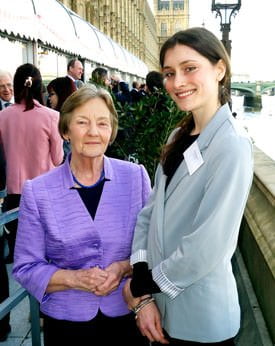
    CIFE Gold Award winner Poppy Waskett with Baroness PerryThe Gold Award winner, Poppy Waskett, an A-level student at Lansdowne College, overcame three years of ill health to achieve three A*s after only one year’s study. She is now reading Experimental Psychology at Oxford University. She said: “I was lucky to have a lot of people around me to encourage me (and remind me when I needed a break!): my teachers, my friends and my mum. My January results were an important foundation, not just for my marks but for my confidence. When I faced the exams in June, I was in the more comfortable position of having a bit of faith that I could obtain the results I needed to fulfil the conditions of my Oxford offer.”. Poppy is pictured with Baroness Perry.
    Baroness Perry, former Chief Inspector of Schools, is the Honorary President of the Council For Independent Education (CIFE). She said: “It is a great pleasure to celebrate the wonderful achievement not only of these outstanding young people, but also their parents for supporting them, and all their teachers and colleges. They have achieved astonishingly good results and my congratulations go to them all.”
    The CIFE Awards Ceremony is kindly sponsored by 360 AdsFab
    CIFE award winners 2012

    The 2012 CIFE Award winners are pictured above.

    CIFE Academic Awards

    CIFE Gold Award,
    This, the top honour, went to Poppy Waskett, of Lansdowne College.
    Paul Kitchener Memorial Foundation Course Award
    Viktoria Löffler (Bath Academy)
    CIFE Award for GCSE
    David Hallam (MPW London)
    CIFE Award for Economics
    Thi Thai Ha Nguyen (Cambridge Tutors College)
    CIFE Awards for Humanities and English
    Maximilian Wagner (Collingham)
    Raweewat Ruechai (Cambridge Tutors College)
    Edmund Speaight (MPW London)
    CIFE Award for Languages
    Sidharth Prabhu-Naik (Lansdowne)
    CIFE Awards for Sciences
    William Wadman (MPW London)
    Hiu Man Lau (Cambridge Tutors College)
    Sher Ee Tan (Cambridge Tutors College)
    CIFE Awards for Visual and Creative Arts
    Katie-Ann McGuigan (MPW London)
    Giles Howdle (Collingham)
    CIFE Andrew Osmond Maths Awards
    Yiyi Yan (Chelsea Independent College)
    Watcharaphol Paritmongkol (Cambridge Tutors College)
    Isarapong Eksinchol (Cambridge Centre for Sixth-form Studies)
    Nguyen Lan Phuong (Brooke House College)
    CIFE Awards for Social Sciences
    Jade Ashcroft (Cambridge Centre for Sixth-form Studies)
    Bao Ngoc Le (MPW London)
    CIFE Value Added Award
    Rizwan Chaudhry (MPW London)

    CIFE College Awards

    Ashbourne Independent Sixth Form College Victoria Pasion
    Bath Academy Anastasia Richmond
    Brooke House College Bui Thi Phuong Hong (Kelly)
    Cambridge Centre for Sixth Form Studies Elizabeth Wark
    Cambridge Tutors College Adeline Lou Yi Wei
    Chelsea Independent College Jasmine Taher
    Collingham Paul Linshits
    DLD College Ming Chen
    Duff Miller Sixth Form College Henry Asson
    Lansdowne College Elizabeth Marshall
    MPW Birmingham Kelly Wilkinson
    MPW London Yusuf Blunt
    Oxford Tutorial College Jessica Hill

  • Government proposals threaten January retakes

    Article in summary

    This article, published in 2012, has partly been superseded by events: January exams have gone, and A-level reform is proceeding apace. For the latest on the changes discussed below see Tour article on the new A-level and GCSE exams. However, we’ve left this article online because it gives useful background to the changes now happening.


    Article in full

    Introduction

    Government proposals threaten January retakes. Education minister Michael Gove says he is determined to overhaul A levels. He feels that they are not tough enough and that they do not prepare students properly for university, so he has asked Ofqual, the body which oversees qualifications, to carry out a review. On June 19th 2012 Ofqual announced a consultation, proposing changes to A level including:

    • Abolishing January exams and allowing students to resit exams only once
    • Ensuring involvement of universities in the design of A levels
    • Considering whether AS levels should continue, and in what form


    Background

    The AS / A2 system was introduced in 2002 as a major overhaul of A levels, making modular assessment the norm for all syllabuses. A-level pass rates jumped from around 70% to over 90%, and have continued to climb ever since. The proportion of top grades has increased too. Commentators and successive governments alike have seen this improvement as a problem, signifying a drop in standards rather than an improvement in absolute performance.

    Mr Gove is only the latest in a series of Education ministers to promise reviews and reform to protect the ‘Gold Standard’ of A levels. Earlier reforms brought in measures such as reducing the number of modules in an A level, stricter control of syllabus content and exam difficulty, and introducing the A* top grade.

    Is there a real problem still to address and are the Ofqual proposals an effective and fair way to proceed?

    The proposal to abolish January exams and limit retakes

    The proposal to abolish January exams and to limit unit resits has been mooted several times before. It is based on three premises. The first is that it is easier for students to do well with exams every half year rather than in the summer only. A second is that exams in January and June are awkward for schools to run, and a third presumes that retaking exams is somehow unfair.

    Is it easier for students? Well, students often improve their grades as a result, but that’s only a problem if there’s no way to differentiate between students for entrance to competitive futures such as university, or if the students’ preparation for those futures is undermined by this schedule of exams. Given that almost all university courses are modular and examined as such, the current half-year exams are arguably a better preparation than a summer-only system. If unit exams are agreed to be too easy, then make the questions tougher. The idea that learning in discrete units robs students of an overview implies that the existing requirement for ‘synoptic’ content (ie questions which require knowledge of wide areas of syllabus) isn’t working properly, not that there should only be an exam at the very end of the course.

    Arguing that life would be easier for school administrators if they didn’t have to organise January exams sounds like the tail wagging the dog. If the most effective way to run A levels includes half-yearly exams it is surely up to schools, which want the best for their pupils, to make the necessary arrangements.

    Finally there is the fairness question. Is it somehow ‘wrong’ that students should achieve a good result after several goes at the exam? If you believe this, some uncomfortable consequences flow for the young people concerned: you are arguing for what is essentially a ‘one strike and you’re out’ approach. As Mario Di Clemente, CIFE Chairman, comments:

    Whilst I share the government’s desire to drive educational standards upwards – and who wouldn’t? – it concerns me that the opportunity which many pupils have enjoyed over many years, and indeed been immensely grateful for, to retake examination units, seems now to be under threat under the new proposals. There is nothing wrong with second chances, particularly when a whole host of valid educational and personal reasons make examination unit resits not only desirable but fair, appropriate and potentially life-changing.

    If on the other hand this proposal is simply another way to make the exam harder then there are fairer ways to achieve that aim.

    The proposal for universities to oversee A-levels

    Involving universities in the content and examination process of A levels is really a shot across the bows of the exam boards which currently run A level. There has been a steady muttering that, because exam boards compete with each other to ‘sign up’ schools, there’s an inevitable tendency for them to make their offerings as student-friendly (= easy) as possible. There may be some truth in this, although exam boards already have their work closely monitored by Ofqual itself.

    Involving universities (in the form of the’ Russell Group’ – deemed to be the most rigorous of the lot) in content and marking may help, though the adage of ‘too many cooks spoiling the broth’ comes to mind. Ironically perhaps, while top universities have been grumbling about poorly prepared entrants, they have greeted this proposal very cautiously, pleading lack of resources to undertake the necessary work. They may well remember past initiatives in which much work has been done, only for proposals to be shelved as the government spotlight turned elsewhere.

    The proposal to review AS levels

    Reviewing AS will be a worthwhile but tricky exercise. The concept of AS is laudable: it was designed to provide a half-way stage for the first year of A levels, introducing skills and content which would be taken to the full level of difficulty in the second year. Students could also take a stand-alone AS to broaden the notoriously narrow sixth-form curriculum. The central difficulty is that results achieved at AS count for a full half of the final A-level result, despite the content of the syllabus and the exam being easier. This has complicated the resit issue too: savvy students retake AS levels in January to get the maximum possible marks in case they do less well on the tougher A2 part of the A-level exam.

    In conclusion

    So, should we welcome the Ofqual proposals? Yes and no. If there are real problems for universities and employers in using A-level results as a reliable indicator of competent candidates, or if A level covers insufficient ground. those issues must be addressed head-on.

    Proposals which are fair to sixth-formers and which address anomalies must be welcomed, but finding back-door ways to increase the failure rate, such as abolishing retakes, is surely wrong.