the sixth-form experts

Call us now for advice
0208 767 8666

CIFE General News Articles

  • Lord Lexden presents 39 CIFE Awards to top students

    Article in summary

    The article describes the 2016 CIFE awards ceremony at the House of Lords, and lists the individual award winners.

    Article in detail

    At the annual CIFE Academic Awards Ceremony held at the House of Lords on Thursday, 7th  April, Lord Lexden presented thirty-nine awards for academic excellence to students who achieved remarkable A-level and GCSE results last summer.  The recipients – some British, some from overseas – were warmly applauded at the presentation, all having studied at sixth-form colleges belonging to the Council for Independent Education (CIFE), of which Alistair Lexden is President. The award-winners typically average 95% + scores in all their A-level exams.

    The CIFE Gold Award, the top prize, went to Vu Thao Dan, known as Ariadne, from Vietnam, a student at Bosworth Independent College in Northampton, who had obtained A* grades in History, Sociology, Economics and Mathematics, along with other international distinctions.  She told us: “I was surprised and delighted to receive a CIFE Academic Award and to discover it was the Gold Award was humbling.  All of the other award winners have done so well and I feel very proud to be in their company at the House of Lords.  I thoroughly enjoyed studying at Bosworth where the teachers and other staff always inspired me to do my very best and to keep up my other interests too.  I felt cared for, as if part of a big family.”  Ariadne is now studying Law at Durham University.

    Lord Lexden said: “Year after year statistics produced by leading international organizations show that our independent schools and colleges provide an education that ranks among the best in the world.  No wonder families here and abroad are so keen to send their children to CIFE’s successful member colleges.  Their outstanding A-level results prove once again that they have fulfilled the trust placed in them.  Their mingling of great talents and different cultures enrich our country and other nations”
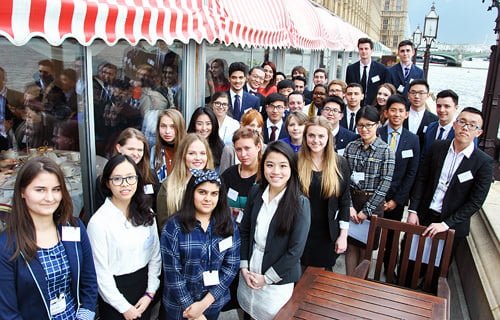
    2016-CIFE-Award-winners-at-House-of-Lords

    2016 CIFE Award winners are pictured above on the House of Lords terrace.

    CIFE Academic Awards

    The individual winners are listed below. Check news items on college pages for details of each student’s achievements.

    CIFE Gold Award
    This is the top award, and was won by Vu Thao Dan (Ariadne) (Bosworth College)

    CIFE awards for Sciences
    Cheuk Ying Karen Ho (CATS College London)
    Youssef Ahmed (Bosworth Independent College)

    CIFE Andrew Osmond Maths awards
    Xinghao Cheng (Cambridge Tutors College)
    Carlos Limpo (Cambridge Tutors College)
    Vo Hung Huu (Brooke House College)

    CIFE awards for Economics
    Yan Yin Lim (Cambridge Tutors College)
    Gaia Maddalena Racca (DLD College)

    CIFE awards for Humanities
    History of Art: Jing Jing Fong (Joyce) (MPW London)
    Geography: Coco Huggins (MPW London)
    English: Alexander Thanki (Collingham College)
    Government & Politics:  Harry Stebbings (MPW London)

    CIFE award for Visual and Creative Arts
    Lidia Makarova (Ashbourne College)

    CIFE award for Languages
    Stephanie Childress (Collingham College)

    CIFE award for Social Sciences
    Alexandra Reid (DLD College)

    CIFE Value Added awards
    Ali Shakarchy (MPW Birmingham)
    Georgia Jeffrey (Bosworth Independent College)

    CIFE award for GCSE
    Corey Markie (Bosworth Independent College)

    Paul Kitchener Memorial Award
    Nadine Tangie (MPW London)

    Baroness Perry Award
    Jin Zheng (Bosworth Independent College)

    CIFE College Awards

    Ashbourne College Nicola Brownless

    Bales College Lilly Connolly

    Bath Academy Henry Gould

    Bosworth Independent College Chong Li Ying (Camilla)

    Brooke House College  Dan Ning

    Cambridge Centre for Sixth-Form Studies Ciara Ward

    Cambridge Tutors College  Carlos Limpo

    Carfax College Huaqing Hong

    CATS College London Bruno Soares

    Chelsea Independent College Zhelong Zhang (Jero)

    Collingham College Willem Nelis

    DLD College   Evelina Polyakov

    Duff Miller College  Alice Hart

    Lansdowne College   JiHo Park

    MPW Birmingham Alex Moran

    MPW London Freddy Champion

    Oxford International College Rafael Peters

    Oxford Tutorial College Mary Gompertz

    Regent College  Shaina Haria

     

    cife college courses provide choice and flexibility

  • Impact of Brexit on education UK

    This article was written in July 2016. Now, in June 2019, we know more about most of the points made below, and what we know confirms that Brexit is likely to damage Education UK, but the key question of how or whether Britain will leave the EU remains unresolved. 

    Amid the talk of the economy, immigration and sovereignty, the impact of Brexit on education UK hasn’t had much of a look in. CIFE Vice-Chair and Principal of CCSS in Cambridge, Stuart Nicholson, decided to put that right by seeking out the views of an expert.

    As Vice-Chair of CIFE my views are often sought on many issues. But when it comes to views on what the educational landscape might look like in a post-Brexit world I decided it best to seek out an expert – Martin Bojam, Education Sector Lead partner at Penna, and an experienced consultant on international and domestic recruitment to the UK Higher Education sector.

    While Martin’s first comment was “Let’s start by accepting one single thing, no one really knows anything”, he was able to guide me through the issues in as even-handed a way as possible, starting with the prospect for UK students wanting to study abroad. “We are inclined to be insular in the best of times, yet in a globalised world, that doesn’t work so well,” he says. “UK students studying abroad have the benefits of an international outlook, and the opportunity to form international networks as well as understanding different cultures.

    Through Erasmus, the student exchange programme, 200,000 UK students have the opportunity to study abroad and statistics show that they are over 50% less likely to suffer long-term unemployment than those who hadn’t studied abroad. Of course exchange programmes would continue, but it would become more difficult for those who wished to study abroad, atmospherically, administratively, eventually perhaps even culturally.”

    And what about research? “It’s been said that  ‘collaboration and support will collapse’, but I think that unlikely. Scientists, researchers and academics are independent-minded and tend to be pragmatic, so they will seek out the best collaborators.  Apparently research with international collaborators is more than 50% more effective – though of course we can seek collaboration anywhere, exchanging EU countries for the Far East perhaps.”

    Would research grants disappear?  “Probably the loss of EU grants would be significant, perhaps running into billions. Over time, one can imagine that the effect of some disengagement would be likely to increasingly isolate ourselves. It’s perfectly true that globally we perform very well at tertiary level – e.g. Nobel prizes per capita – and there is no reason to believe that Brexit itself would affect that other than in the long term.”

    And what about students coming here to study? Would we still attract the brightest and best staff and students? “EU students make up five per cent of the higher education student body and EU staff make up 15% of the academic staff in UK institutions.  In 2014, over 50% of European Research Council Consolidator Grants awarded to UK universities were won by academics who came from other EU countries.  I think coming here would inevitably become more difficult as part of the process of ‘securing our borders’.

    It is said that non-EU students would not be affected by Brexit – but recent polling (and I take it with a little pinch of salt) indicates that for non-EU students, a UK outside the EU is a less attractive destination, and that is even more the case for EU students.  At the very least Brexit must make it more likely that staff and EU students will consider other destinations.

    Finally, on a more positive note, there’s the consideration of cost. Although decisions on education aren’t swayed much by small cost changes, if the pound sterling loses considerably against the dollar, studying in the UK becomes cheaper and that would help schools and universities alike.”

    What impact could this have on the UK economy? “Our education exports are very significant in economic terms – some £17.5bn.  In many areas the student population is a (or even the) major contributor to the local economy. Although the number of EU students is not significant in most locations, there are some where they are of substantial economic importance.

    Summer schools and especially language schools could be very badly affected, as a high proportion of their income comes from EU students.  I don’t think numbers would totally collapse, but if one assumes a much tougher visa entry regime it becomes more difficult, and where it’s difficult people will find other alternatives. And that’s probably the most prevalent danger overall – people have choice, and will exercise it, to our detriment.”

  • CIFE colleges welcome international students

    Lord Lexden, President of CIFE, discusses how CIFE colleges support international students

    CIFE colleges get good results

    Year by year excellent examination results are consistently achieved by British and international students at the thriving 25 independent sixth-form colleges which comprise the Council for Independent Education (CIFE), founded 45 years ago with rigorous external inspection as one of its conditions of membership. Success at CIFE colleges is rewarded with the university place for which a CIFE education has been the demanding preparation—and at a top university for some 50 per cent of those who have benefited from the CIFE experience.

    Every spring I present special CIFE awards, some 40 altogether, at the House of Lords to the most outstanding students of all, bristling with A*s and As at A-level in a diverse range of arts and scientific subjects. There are awards too for contributions to college and wider community life for which competition is keen among both British and international students. A CIFE education is never focused exclusively on academic excellence, crucial though that is.

    International students enrich learning

    At these annual awards ceremonies I meet CIFE principals and teachers who tell me of the joy and satisfaction they derive from bringing together students from a wide variety of different countries, and watching friendships develop between them, assisted by the sporting and cultural activities that thrive alongside intense study.

    I also meet proud parents, many of whom have travelled from other continents to applaud the successes of their sons and daughters. They tell me how much it means to them that their children have not only benefited greatly from a CIFE education but have also been enriched by experience of British life, as well as by the friendships they have formed with fellow students from different cultures.

    At Bosworth Independent College in Northampton international students account for 65 per cent of the total and come from 35 different countries. This appeals to British students. “They often comment on how much they appreciate the global feel of our community,” said Fiona Pocock, the College’s Principal.

    The UK needs to make international student entry easier

    Over the last 10 years more than 15,000 international students have passed successfully through CIFE colleges on their way to British universities. It is of course an understatement to say that the government in general—and Mrs May in particular –could do more to help strengthen international recruitment by Britain’s academic institutions of which CIFE forms part.

    In both Houses of Parliament there is overwhelming opposition to the inclusion of overseas students in the official immigration figures. In the Lords, members of all parties denounce the present arrangements whenever they are discussed and call for the revision of entry requirements to end the existing complexity. Major changes are needed, particularly at a time when Brexit is adding to the challenges. On a visit to Nigeria a CIFE college principal was told that Canada was beginning to be seen as more attractive than the UK.

    CIFE colleges welcome and support international students

    CIFE colleges adopt no single, common approach to international students. As Dr Sally Powell, Principal of Collingham College in London, puts it, “CIFE colleges all have their own personalities. They have different combinations of international and domestic students, different kinds of facilities and different types of building that affect their characters. What they have in common is a dedication to individualised learning made possible by the very small groups within which students are taught.

    This concern for individual wellbeing is to be seen prominently in the way CIFE colleges respond to applications from overseas. Dedicated staff provide as much initial advice and guidance as families require. At MPW College in London, the Principal, John Southworth, “has an experienced international team fluent in most languages to respond to parents’ enquiries.” He also has “full-time compliance officers to oversee the visa application process and check documentation before submission”.

    Such services are widespread. Mike Kirby, Principal of Ashbourne College in London, arranges “detailed Tier 4 visa advice; it is rare for a visa to be refused. We also organise a tour of London at the beginning of the academic year and a comprehensive induction day.

    At Bosworth College nothing is left to chance. Fiona puts the families of prospective students in touch with current or past students. Before they arrive, “we encourage them to visit our virtual learning environment and to use our college email”. No conceivable requirement is neglected. A new student who needs “his or her dental brace tightened” will immediately be told what to do; “a caring college team thinks in advance of such concerns.” The CIFE objective, she added, is to ensure “a collaborative and caring relationship between home and college.No wonder the families of international students make such appreciative comments when I meet them at the Lords.

    Alistair Lexden is a Conservative peer and historian. He has been President of CIFE since 2014.


    cife college teaching is results focussed

  • CIFE football tournament 2018

    Many congratulations to Brooke House on becoming the CIFE football champions for 2018.

    On Friday 13th April 2018 teams from seven CIFE colleges spent a day at St George’s Park, home to England’s 24 national teams, and one of the best facilities for football in the world.

    Teams came from Ashbourne, Bosworth, Brooke House, Cambridge Centre for Sixth-form Studies, Collingham, MPW Birmingham, and MPW London.

    After a keenly contested Group Stage in the morning, four teams went through to the semi-finals where Brooke House beat Ashbourne 4 – 0, and MPW Birmingham beat Collingham 1- 0. In the final Brooke House ran out easy 4 – 0 winners. But then Brooke House in one of the few colleges in England running a dedicated football development course!

    A great place to play, and many thanks to MPW Birmingham for organising the tournament.


    cife college teaching is results focussed

  • Top students receive 2018 CIFE Awards from Lord Lexden

    Article in summary

    The article describes the 2018 CIFE awards ceremony at the House of Lords, at which CIFE President, Lord Lexden presented prizes to 41 high achievers from CIFE colleges.

    Article in detail

    At the annual CIFE Academic Awards Ceremony held at the House of Lords on Wednesday, 18th April, Lord Lexden presented awards for academic excellence to forty-one students who achieved remarkable A-level and GCSE results last summer. The recipients – some British, some from overseas – were warmly applauded at the presentation, all having studied at sixth-form colleges belonging to the Council for Independent Education (CIFE), of which Alistair Lexden is President.

    The top prize, the CIFE Gold Award, was won by Howard Xu from China, a student at MPW College, Birmingham, who had obtained A* grades in Mathematics, Further Mathematics, Additional Further Mathematics, Physics and Chemistry. He told us: “I am delighted to have received the CIFE Gold Award at the House of Lords. I am very surprised and never expected to gain this honour. I would like to thank all my teachers at MPW and my parents who have always believed in me. I love mathematics and I love studying in England. Eventually I hope to teach Mathematics at university and to carry out research that will take our understanding of the subject further.” Howard is now studying Mathematics at Oxford University.

    Lord Lexden said: “This event recognises and celebrates tremendous academic achievement in our national exams by students from all over the world. It is an important acknowledgement of the success not only of the pupils themselves, but also of their teachers, and of their families who entrust their children to our independent sixth-form colleges. At a time of worrying uncertainty about Britain’s future created by Brexit, CIFE and its member colleges will continue to spread the message at home and especially abroad that they intend to play a full part in maintaining our world-class reputation for scholarship and in welcoming international students to the UK, as they have always done.

    The 2018 CIFE awards ceremony was supported by Double First and by Wesleyan Financial Services, both sponsors of the work CIFE colleges do.


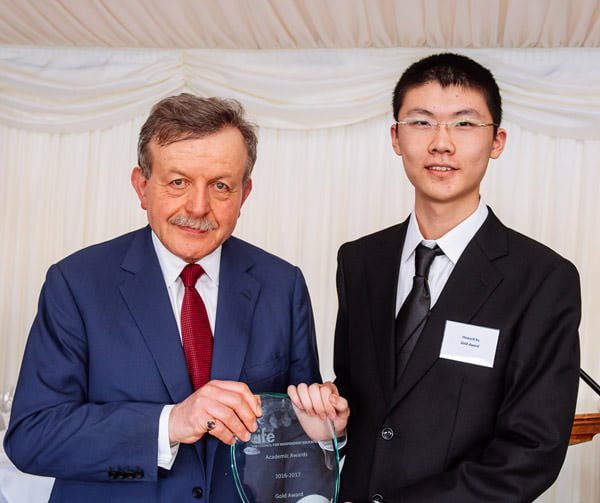
    Lord Lexden with CIFE Gold Award winner Howard Xu

    Lord Lexden presents the 2018 CIFE Gold Award to Howard Xu

    CIFE Academic Awards

    The individual winners are listed below.

    CIFE Gold Award
    Howard Xu (MPW Birmingham)

    CIFE awards for Sciences
    Jamie Gerstein (Ashbourne Sixth Form College)
    David Robson (Cambridge Centre for Sixth-form Studies)
    Phitawat Namnouad (Oxford Tutorial College)

    CIFE Andrew Osmond Maths awards
    Vivian (Bohan) Zhang (DLD College)
    Zihao Su (MPW London)
    Jiazheng (Dean) Zhu (Ashbourne Sixth Form College)

    CIFE award for Economics
    Rosemond Tan (MPW Birmingham)

    CIFE awards for Humanities
    Nathaniel Jenkins (MPW London)
    Lucy Robb (Collingham College)
    Bb Prendiville (MPW London)
    Albert Maguire-King (MPW London)

    CIFE award for Visual and Creative Arts
    Jinlin Fang (Ellen) (MPW London)

    CIFE award for Languages
    Giorgio Piano (MPW London)

    CIFE award for Social Sciences
    Gaya Ramanathan (MPW Birmingham)

    CIFE Value Added awards
    Harris Barr (Collingham College)
    Lucy Brosch (Bath Academy)

    CIFE award for GCSE
    Darin Hansakul (Bosworth Independent College)

    Paul Kitchener Memorial Award
    Piero Rubini Cansino (Bath Academy)

    Baroness Perry Award
    Sam Stark (Cambridge Centre for Sixth-form Studies)

    CIFE College Awards

    Acorn House College Ayesha Iqbal
    Ashbourne College Melissa Chekera
    Bales College Mohammed Blaaza
    Bath Academy Thomas Lewin
    Bosworth Independent College Gary Abbass
    Brooke House Duyen Ky Cao (Jenny) and Hai Vu Quach (Jonny)
    Cambridge Centre for Sixth-Form Studies Chanheum (Alex) Lah
    Cambridge Tutors College Darrell Lee
    Carfax College Sam Abrahams
    CATS College Cambridge Ziwen Liu (Arno)
    CATS College London Husam Zergani
    Chelsea Independent College Enxhi Sharxhi
    Cherwell College Wenxi Zhang
    Collingham College Agnes Wilhelmsen
    DLD College Vasily Rublev
    MPW Birmingham Chris Moran
    MPW London Scarlett Murray
    Oxford International College Yee Kei Lam (Kate)
    Oxford Tutorial College Chattawat Thangsrikeattigun
    Regent College Osamu Allman


    cife college results show high added value